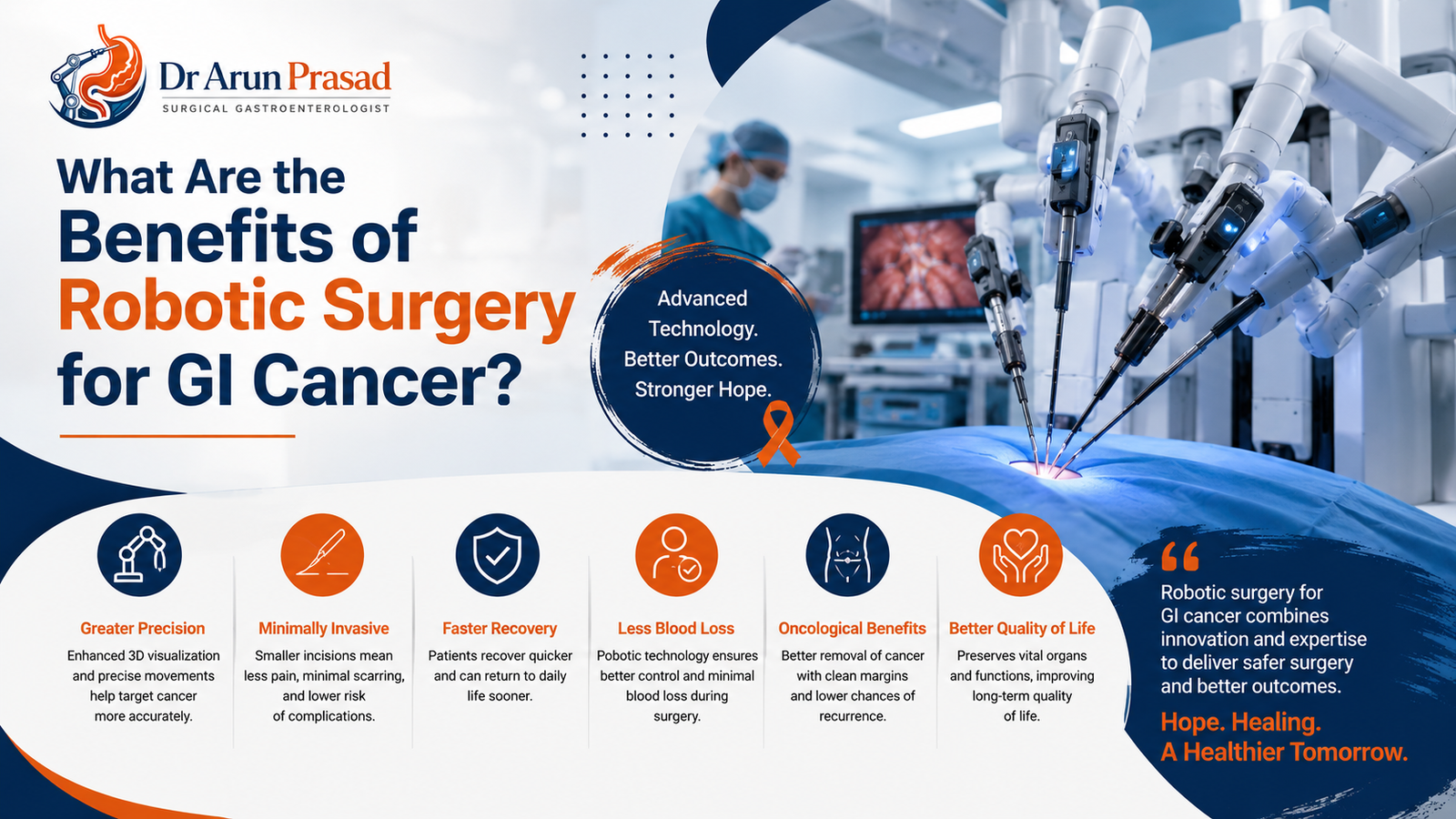
Robotic surgery has become an important advancement in the treatment of gastrointestinal (GI) cancers. For patients considering advanced cancer treatment, choosing an experienced Robotic GI Surgeon in India can help ensure that the benefits and limitations of robotic surgery are properly evaluated for their individual condition. Robotic assisted surgery can provide enhanced visualization, precise instrument control, and minimally invasive access, making it a valuable option for selected GI cancer procedures.
What Is Robotic Surgery for GI Cancer?
Gastrointestinal cancer can affect different parts of the digestive system, including the esophagus stomach liver pancreas colon, rectum, and other organs.
Robotic GI surgery is a minimally invasive approach in which the surgeon controls specialized robotic instruments from a console. The robotic system does not operate independently. Instead, it translates the surgeon’s hand movements into precise movements of the instruments inside the patient’s body.
The technology provides a magnified three dimensional view of the surgical field and allows highly articulated instrument movements. These features can be particularly useful when cancer surgery requires precise dissection around delicate tissues and important blood vessels.
Why Is Robotic Surgery Being Used for GI Cancer?
Cancer surgery often requires removal of the tumor along with an appropriate margin of surrounding tissue and in many cases nearby lymph nodes. Depending on the cancer location and stage the operation can be technically complex.
Traditional open surgery may require a larger incision to provide access to the affected area. Laparoscopic and robotic techniques allow surgeons to perform many procedures through smaller incisions.
Robotic surgery may be particularly useful when the surgical area is difficult to access or when precise movements are required in confined anatomical spaces.
Benefits of Robotic Surgery for GI Cancer
1. Enhanced 3D Visualization
One of the major benefits of robotic surgery is the surgeon’s enhanced view of the operating field.
The robotic platform provides a magnified three-dimensional image, which can help the surgeon identify anatomical structures more clearly. This can be particularly valuable during complex cancer procedures where careful dissection is required.
2. Greater Surgical Precision
Robotic instruments provide wrist like articulation and a wide range of movement.
This allows the surgeon to perform controlled movements during tumor dissection, lymph-node clearance suturing and reconstruction. Precision can be particularly important when operating near major blood vessels nerves or other critical structures.
3. Minimally Invasive Approach
Robotic surgery generally uses several small incisions instead of the larger incision associated with many open procedures.
For appropriately selected patients smaller incisions may contribute to:
- Less tissue trauma
- Reduced postoperative discomfort
- Smaller scars
- Earlier mobility
- Potentially shorter hospital stays
- Faster return to routine activities
The exact recovery time varies according to the cancer type, operation performed, patient’s health and complexity of surgery.
4. Better Access to Difficult Anatomical Areas
Certain areas of the gastrointestinal tract can be challenging to reach using conventional instruments.
Robotic instruments can provide greater flexibility inside the body, allowing the surgeon to work in narrow or difficult to access spaces.
This can be particularly helpful during selected colorectal, rectal, esophageal, gastric, and other complex GI procedures.
5. Precise Lymph Node Dissection
Cancer surgery frequently involves removal of regional lymph nodes for accurate staging and treatment.
The improved visualization and instrument control provided by robotic surgery can assist surgeons during meticulous lymph node dissection while preserving important surrounding structures.
However, the quality of cancer surgery ultimately depends on appropriate oncological planning and the surgeon’s expertise rather than the robotic platform alone.
6. Potentially Faster Recovery
Because robotic surgery is minimally invasive suitable patients may experience a smoother postoperative recovery compared with some open procedures.
Earlier mobility can be particularly valuable for cancer patients because maintaining nutrition, physical activity and overall strength can support recovery after major surgery.
Nevertheless robotic surgery does not guarantee a faster recovery for every patient.
Is Robotic Surgery Better Than Open Surgery for GI Cancer?
There is no single answer for every cancer patient.
Robotic surgery can provide technical advantages, but it is not automatically the best approach for every GI cancer. The decision depends on:
- Type of cancer
- Stage of cancer
- Tumor location
- Tumor size
- Involvement of nearby organs or vessels
- Previous abdominal surgery
- Patient’s overall health
- Surgeon’s expertise
- Availability of appropriate robotic technology
For some patients, open surgery may remain the most appropriate option, especially when the disease is extensive or requires complex multiorgan surgery.
The goal should always be complete and safe cancer treatment, rather than choosing robotic surgery simply because it is technologically advanced.
Robotic Surgery for Different GI Cancers
Robotic techniques may be used in selected patients with different gastrointestinal cancers.
Robotic Colorectal Cancer Surgery
Robotic surgery can be useful in selected colon and rectal cancer procedures. The enhanced visualization and flexible instruments can be particularly helpful in the confined pelvic region during rectal surgery.
Robotic Stomach Cancer Surgery
For selected gastric cancer patients, robotic surgery can assist with stomach resection and lymph node dissection while using minimally invasive access.
Robotic Esophageal Cancer Surgery
Esophageal cancer surgery can involve technically demanding dissection and reconstruction. Robotic technology may provide enhanced visualization and precise instrument movement during selected procedures.
Robotic Liver and Pancreatic Surgery
Selected liver and pancreatic operations can also be performed using robotic techniques in experienced centers. However, these procedures can be highly complex and require careful patient selection and specialized expertise.
Why Surgeon Experience Matters
The robotic system is a tool. It is the surgeon’s training, judgment, experience, and understanding of cancer surgery that determine how that technology is used.
An experienced robotic GI surgeon should understand both minimally invasive and open surgical techniques. This allows the surgeon to select the most appropriate approach rather than forcing every patient into a robotic procedure.
Patients should ask about the surgeon’s experience with:
- Robotic GI cancer procedures
- Advanced laparoscopic surgery
- Complex abdominal surgery
- Cancer staging and surgical planning
- Lymph node dissection
- Open surgery when required
- Postoperative cancer care
Why Choose Dr. Arun Prasad?
Dr. Arun Prasad has extensive experience in gastrointestinal, laparoscopic, bariatric, and robotic surgery. According to his official profile, he has more than 30 years of surgical experience and has performed more than 15,000 procedures. His website also states that he has completed more than 1,000 robotic procedures and has been performing robotic surgery since 2012.
His training includes an MS in Surgery from Maulana Azad Medical College, New Delhi, advanced GI surgical training at Charing Cross Medical School, London, and FRCS (UK). His professional journey has focused extensively on gastrointestinal and minimally invasive surgery. Dr. Prasad has also been involved in the development and teaching of robotic surgery. His official profile records his involvement in robotic surgery since its early adoption in India, along with participation in international surgical meetings, workshops, lectures, and live robotic demonstrations.
For patients looking for a Robotic GI Surgeon Delhi, this combination of long-term GI surgical experience, advanced minimally invasive expertise, and robotic experience can be important when evaluating treatment options.
What Should Patients Consider Before Robotic GI Cancer Surgery?
Before deciding on robotic surgery, patients should have a detailed consultation with their surgical team.
Important questions include:
- What type and stage of GI cancer do I have?
- Is surgery appropriate for my cancer?
- Is robotic surgery suitable for my particular tumor?
- What are the alternatives?
- Will lymph nodes need to be removed?
- What are the expected benefits and risks?
- How long might recovery take?
- What additional cancer treatment may be required?
A multidisciplinary approach involving surgeons, oncologists, radiologists, pathologists, and other specialists may be appropriate depending on the cancer.
Final Thoughts
Robotic surgery has changed the possibilities for minimally invasive gastrointestinal cancer treatment. Enhanced three-dimensional visualization precise instrument control, improved access to difficult anatomical areas and smaller incisions can make robotic surgery valuable for appropriately selected patients.
However robotic surgery should not be viewed as a replacement for surgical expertise. The most important factors are accurate diagnosis appropriate cancer staging, sound surgical planning complete cancer removal and experienced postoperative care.
If you are considering robotic treatment for gastrointestinal cancer, consulting an experienced Robotic GI Surgeon in India can help you understand whether robotic surgery is appropriate for your specific cancer and overall health.
FAQs
1. Is robotic surgery safe for GI cancer?
Robotic surgery can be safe for appropriately selected patients when performed by an experienced surgical team.
2. Does robotic surgery remove cancer completely?
The goal is complete removal of the cancer when surgery is appropriate but outcomes depend on the cancer type and stage.
3. Is robotic GI cancer surgery better than open surgery?
It can offer minimally invasive advantages for selected patients but open surgery may be preferable in some cases.
4. How long does recovery take after robotic GI cancer surgery?
Recovery varies according to the cancer procedure patient’s health and complexity of surgery.
5. Who is a candidate for robotic GI cancer surgery?
Candidates are determined after evaluating the cancer type stage tumor location overall health, and surgical requirements.
Laparoscopic Surgery in Delhi , Upper GI Surgery in Delhi , Advanced Robotic Surgery Treatment , Robotic Gastrointestinal Surgery